

OUR POV ON PX MATURITY
Move PX from fragmented activity to business-aligned impact.
Most organizations do not lack People Experience initiatives. They lack a connected system for turning employee needs and insights into better journeys, stronger ways of working, and measurable business value.
The Impact PX Maturity Model helps leaders understand how well that system works today, where the most important gaps exist, and what to strengthen next.
PX maturity is not more PX activity

Organizations invest in surveys, technologies, programs, processes, and individual moments that matter. Yet these efforts often operate independently across HR functions, business units, systems, and regions.
The result can be a great deal of activity without a coherent People Experience.
PX maturity is the organization’s ability to connect strategy, ownership, employee insight, end-to-end journeys, digital experiences, delivery capabilities, and measurement into a system that continually improves how people experience work.
“Mature PX organizations do more than design good experiences. They build the organizational capability to prioritize, deliver, measure, and continuously improve them.”
How we think about PX maturity
Maturity is systemic
A strong survey program, HR platform, or journey project does not make an organization mature on its own. Maturity depends on how capabilities work together across the enterprise.
Maturity is evidence-based
Leadership intent is important, but maturity must be supported by consistent practices, decisions, behaviors, governance, measures, and demonstrable business outcomes.
Maturity is contextual
Organizations do not need to advance every capability at the same pace. Priorities should reflect business strategy, employee needs, operating realities, risks, and readiness.
Maturity is a path
A benchmark should create shared understanding and practical action, not simply produce a score. Its value comes from helping leaders determine what to strengthen next.
Maturity drives business value
The goal is not maturity for its own sake. It is a stronger ability to improve work, reduce friction, support people, manage risk, and contribute to business performance.
THE IMPACT PX MATURITY MODEL
Six connected capabilities. One enterprise PX system.
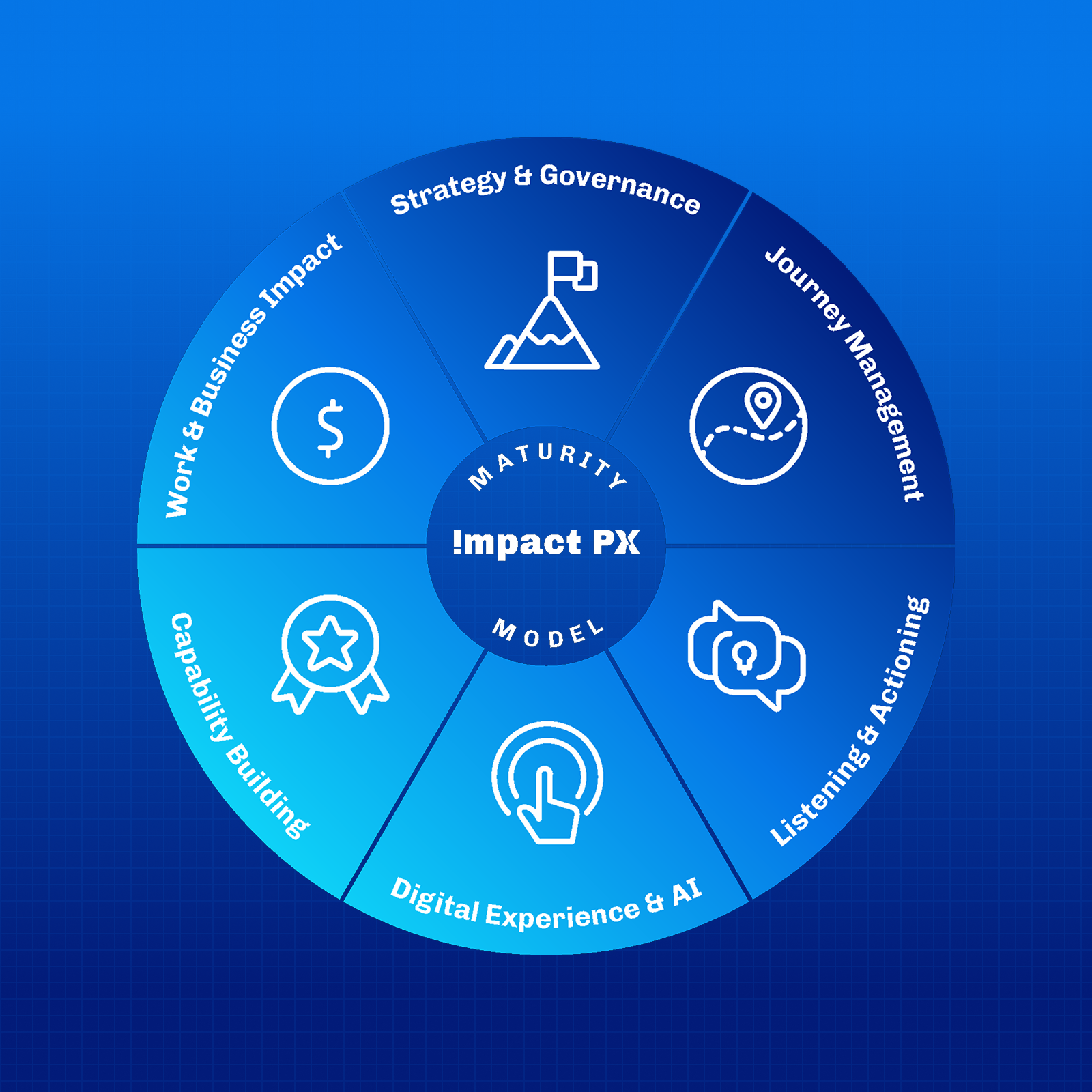
Our proprietary model reflects decades of experience leading and enabling People Experience inside complex, global enterprise organizations. It assesses six capabilities required to move from isolated PX activity to an integrated, business-aligned discipline.
1. Strategy & Governance
Clarifying the PX vision, ownership, decision rights, priorities, investments, and operating model required to lead the work.
2. Journey Management
Managing end-to-end employee journeys with accountable owners, cross-functional teams, roadmaps, performance measures, and continuous improvement.
3. Listening & Actioning
Building an integrated listening system that turns employee insight into decisions, action, measured improvement, and visible follow-through.
4. Digital Experience & AI
Creating coherent digital experiences and adopting AI in ways that are useful, accessible, trusted, integrated, and responsibly governed.
5. Capability Development
Equipping leaders, teams, and practitioners with the skills, tools, communities, and ways of working needed to deliver PX consistently.
6. Work & Business Impact
Measuring improvements in people’s experience of work and connecting them to adoption, productivity, performance, retention, cost, risk, and other business outcomes.
Each dimension is evaluated through a detailed evidence framework and five-level maturity rubric.
Exploratory
Emerging
Operationalized
Integrated
Business-aligned
Organizations may operate at different levels across the model. These differences help reveal where capability gaps, dependencies, and opportunities could limit progress elsewhere.
FROM ASSESSMENT TO ACTION
The PX Maturity Benchmark & Roadmap
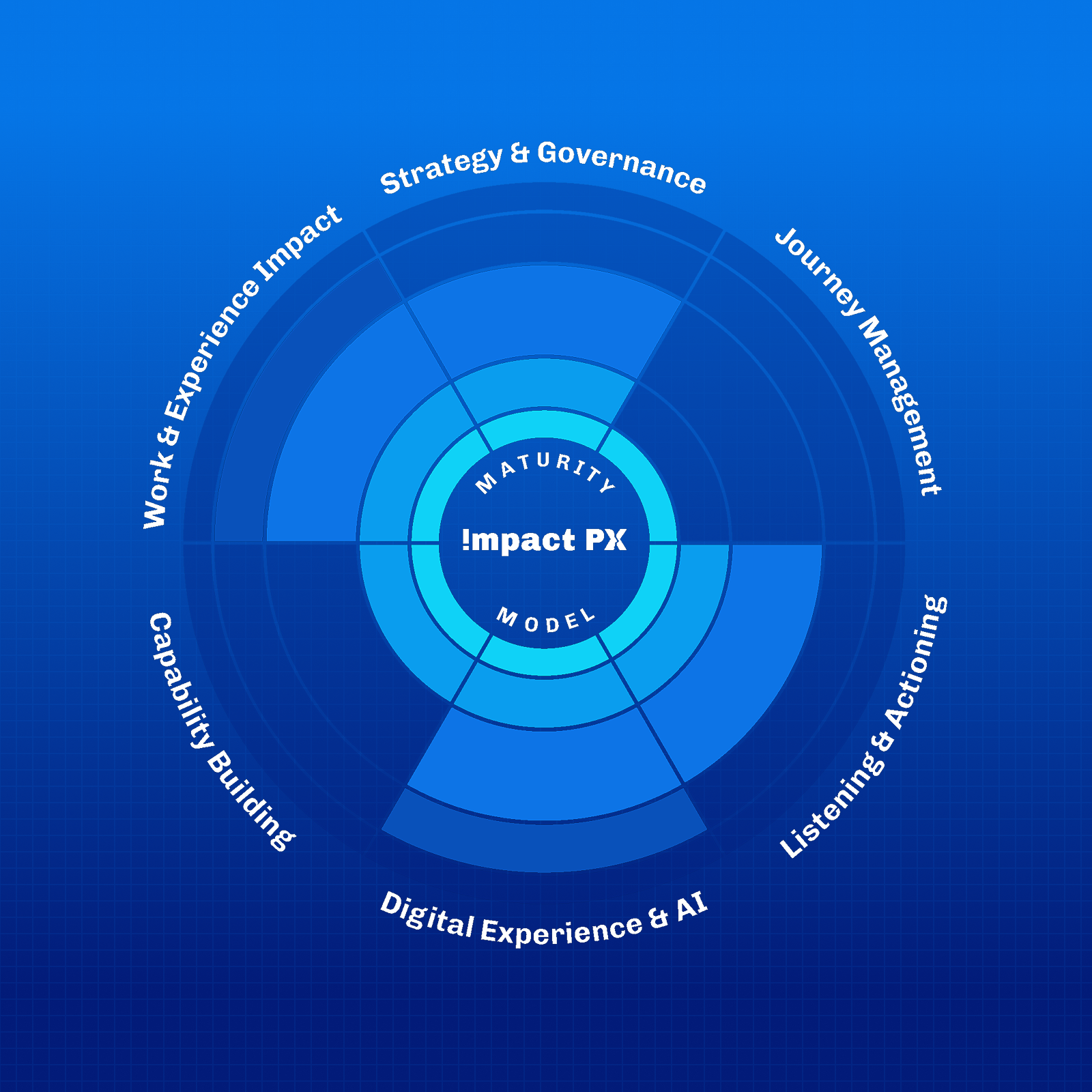
See where you are. Align on what matters. Build a practical path forward.
The Impact PX Maturity Benchmark & Roadmap provides an evidence-based view of your organization’s current PX maturity and a prioritized plan for advancing it.
We bring together stakeholder perspectives, organizational evidence, existing research, and enterprise context to distinguish stated ambition from established capability. We then work with leaders to align on the findings and translate them into focused, achievable action.
The engagement helps answer five essential questions:
Where are we today?
What is working well?
Which gaps are limiting our progress?
What should we prioritize next?
How do we build and sustain the capabilities required?
How the benchmark works
1. Frame the benchmark
Align on business context, scope, stakeholders, current PX priorities, and the decisions the benchmark needs to support.
2. Gather evidence
Conduct structured stakeholder interviews and review relevant strategies, operating practices, research, measures, governance, tools, and organizational artifacts.
3. Synthesize and calibrate
Evaluate evidence against the model, identify strengths and gaps, assess confidence, and uncover cross-dimensional dependencies.
4. Align leaders
Bring leaders together around a shared view of current maturity, the implications for the organization, and the capabilities that matter most.
5. Build the roadmap
Translate findings into prioritized recommendations, sequenced actions, ownership considerations, and a practical path forward.
What you receive
Enterprise maturity profile
A clear view of maturity across the six connected dimensions, supported by evidence and confidence levels.
Executive findings
A concise synthesis of strengths, gaps, risks, dependencies, and implications for PX strategy and delivery.
Prioritized recommendations
Practical recommendations focused on the capabilities and actions most likely to unlock meaningful progress.
Phased roadmap
A sequenced plan that distinguishes near-term actions, foundational capabilities, longer-term priorities, and key dependencies.
Leadership alignment
A facilitated executive playback and working session to build shared understanding, resolve differences, and align around next steps.
Rebenchmarking baseline
A consistent baseline that can be revisited over time to evaluate progress, changing priorities, and the impact of investments.
IS IT TIME?
When to consider a PX Maturity Benchmark
A PX Maturity Benchmark & Roadmap may be especially valuable when:
You are defining or refreshing your PX strategy.
PX initiatives are active but fragmented across teams or functions.
Leaders do not share a consistent view of current maturity or priorities.
You need to decide where to focus limited capacity and investment.
Listening generates insight, but action and follow-through remain inconsistent.
You want to move from isolated journey projects to ongoing Journey Management.
Digital platforms or AI investments are advancing without a connected PX direction.
Leadership is asking for clearer evidence of PX value and business impact.
A new PX or HR leader needs an evidence-based enterprise baseline.
You want to evaluate progress since an earlier strategy, transformation, or benchmark.
DESIGNED FOR COMPLEX ORGANIZATIONS
Enterprise rigor without the traditional consulting model
The benchmark is designed for organizations operating across functions, business units, technologies, and regions. It accounts for the realities that often determine whether PX can progress: competing priorities, unclear ownership, legacy technology, local requirements, change fatigue, investment constraints, and cross-functional dependencies.
The work is led by practitioners who have built and led People Experience capabilities inside global enterprises. We combine a rigorous evidence model with a pragmatic focus on the decisions and actions your organization can realistically take.
Frequently asked questions
-
No. Stakeholder interviews are an important evidence source, but the benchmark also considers organizational artifacts, established practices, governance, measures, delivery evidence, and enterprise context. It does not rely on perception alone.
-
The benchmark is developmental rather than compliance-oriented. It identifies strengths, gaps, and risks, but its primary purpose is to build alignment and guide practical improvement.
-
Not necessarily across every capability at the same time. The appropriate ambition depends on your strategy, employee needs, organizational context, and the value that greater maturity would create.
-
Yes. A full enterprise benchmark provides the most connected view, but Dimension Deep-Dives can examine a priority capability such as Journey Management, Listening & Actioning, or Digital Experience & AI.
-
Yes. Rebenchmarking creates a consistent way to evaluate progress, identify new gaps, and adjust priorities as the organization and its strategy evolve.
-
Timing depends on scope, organizational complexity, stakeholder availability, and the number of business units or regions included. We define the recommended approach and timeline during the initial scoping conversation but have completed some in as little as two weeks.
READY TO UNDERSTAND YOUR PX MATURITY?
Turn your current state into a focused path forward.
A PX Maturity Benchmark & Roadmap can help your leaders build a shared view of where you are, determine what matters most, and make more confident decisions about what to strengthen next.